Love, Hate, and Hunger: The Theology of Nutrition
I have a love-hate relationship with food.
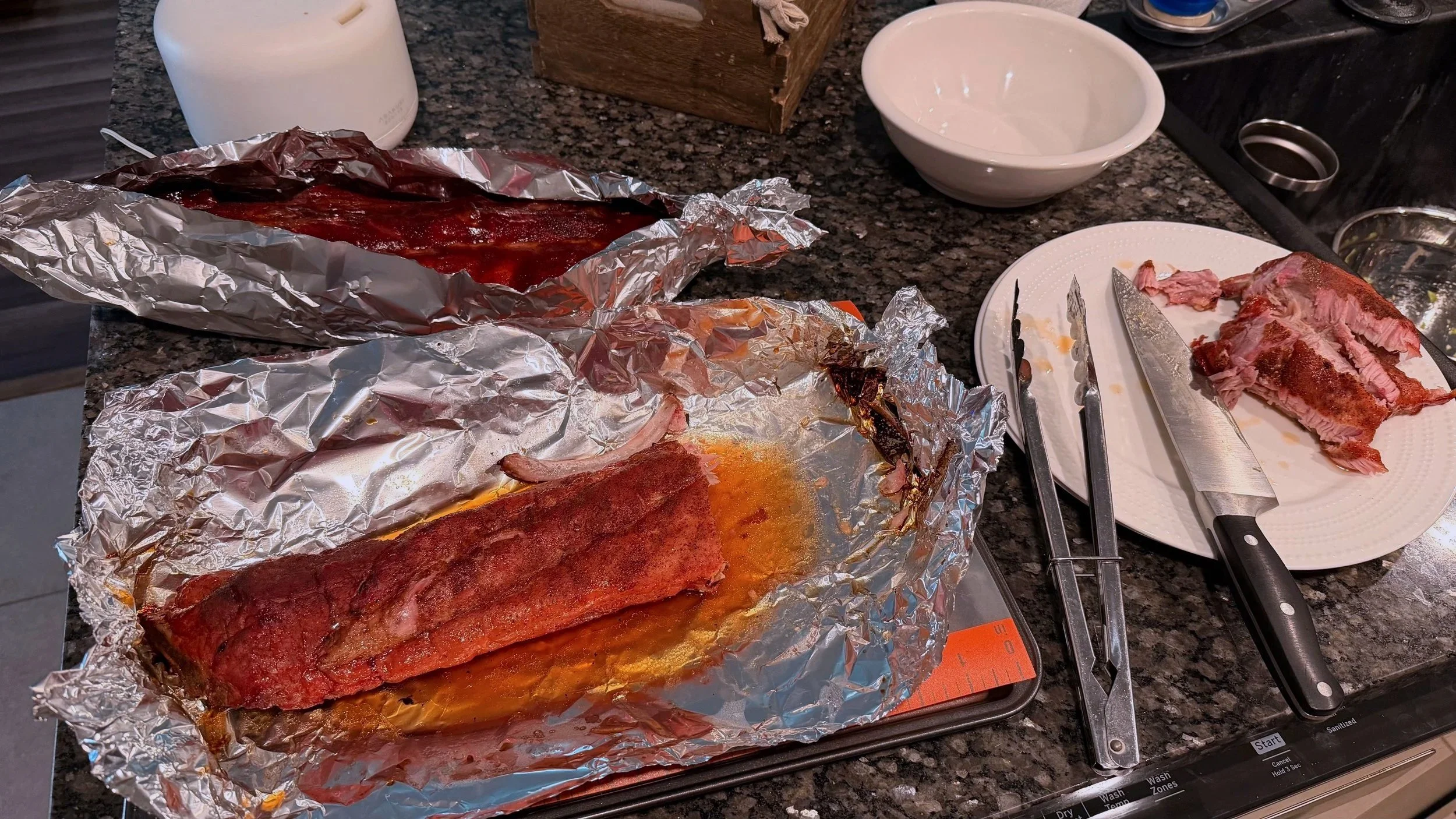
3-2-1 ribs from my smoker. The pink ring is real.
On one hand, I love to eat. I've been hungry my entire life, or at least it feels that way. There's always this gnawing feeling in my belly, something that can never quite be filled, or if it is, only momentarily. I am a man who genuinely enjoys a meal.
On the other hand, I'm vain. There's a voice in the back of my head that never fully goes away: don't get fat, please don't get fat. It's a low-grade body dysmorphia that tightens its grip as I get older, as the metabolism slows, as the mirror tells a slightly different story than it did at 30. And so I hate to eat.
I exist in this tension constantly. One part of me wants more. The other part is afraid of what more costs. And for a long time, I tried to manage that tension with better systems. Better macros. Better timing. Better tracking.
What I actually needed was a better theology.
Most of us come to food with a framework that's either moralized (clean eating is a virtue, junk food is a guilt) or purely mechanical (calories in, calories out, nothing more, go run off that donut you just ate). I had both simultaneously, which is its own kind of chaos.
Scripture offers a third way, though, and it’s not a meal plan, but more of a posture. It’s a theology of the body, and from that, everything about how we eat follows.
Take this passage, for example:
"Or do you not know that your body is a temple of the Holy Spirit within you, whom you have from God? You are not your own, for you were bought with a price. So glorify God in your body." (1 Corinthians 6:19-20)
Interestingly, the Greek word translated "glorify" here is doxazō, which means to honor, to magnify, or to make the worth of something visible. Paul's instruction isn't "maintain your body." It's "make God's worth visible through your body." That's a completely different assignment than either of the frameworks most of us are running.
This passage gets preached almost exclusively in the context of sexual ethics, and it belongs there for the most part. But the principle underneath it is wider than that. The body is not incidental to the Christian life. It is the location where the Christian life is lived.
When Paul says "you are not your own," he's making a stewardship argument. He’s saying, “You don't own this body. You're managing something that belongs to someone else.” That reframes the entire conversation about food.
It reframes the obsessive side:
relentless optimization
the anxiety about every meal
the fear of getting fat.
That's not stewardship. That's just self-worship with better macros. When your relationship with food is driven by vanity or fear, you are still centering yourself. You've just dressed it up in discipline. It’s narcissism at its core.
But it also reframes the neglectful side:
skipping meals because you're too busy
eating whatever is convenient and never thinking about the downstream cost
treating the body like it doesn't much matter because spiritual things are what count.
That's not humility. That's neglect of something God called you to steward.
Stewardship lands in the middle.
It's intentional without being anxious. It's caring without being consuming. The goal isn't a perfect physique or a perfect diet. The goal, in Paul's own words, is to glorify God in the body. To make God's worth visible through how you live in this thing He gave you.
That changes what a question like "should I eat this?" is actually asking. It becomes less of a morality question and more of a stewardship quesion. “Am I allowed?” becomes, “Does this serve the purpose?”
This week, try replacing the framework you're currently using with a stewardship question.
Not "will this make me fat?" or "does this fit my macros?"
Ask instead: "Am I caring for what God entrusted to me?"
Sometimes that means eating more. A lot of active people are under-fueling without realizing it. Do you have poor recovery, persistent fatigue, and strength that won't budge despite consistent training? That’s often a food problem, not a training problem. Neglecting to eat enough isn't discipline. It's negligence.
Sometimes that means eating with more intention. Sitting down. Slowing down. Not eating in front of an open refrigerator at 10pm because you forgot to prioritize it all day.
Here’s a practical starting point: track your protein for one week. Just your protein. Not obsessively, just honestly. Most people training at any serious level are meaningfully short of where they need to be, and the cost shows up everywhere.
The goal isn't to optimize. The goal is to steward. There's a difference, and the difference will change your relationship with food more than any new meal plan ever could.
The tension I described at the top? The love and the hate, the hunger and the fear? I don't think it disappears with better theology. But it does get reoriented.
You were bought with a price. That means your body has dignity. It means what happens to it matters. It means the act of feeding yourself well is not vanity and not obsession. It is, in the most ordinary and practical sense, an act of honoring the One who made you.
Eat like it.