Before You Can Lead, You Have to Run
There's a small group I lead.
Good people. Real community. And a few months ago, one of the members left without warning. No explanation, just gone. We had a couple of conversations, a disagreement, and then he was gone. And it was painful.
We had a group meeting that night. They would be looking to me for the answers as to “why.” And I had nothing.
I didn't want to go to group that night. Not because I didn't care, but because I cared too much and had nothing to give yet.
So I did what any other idiot would have done. I ran away. Literally. I slapped on my Brooks and headed out the door before the day had any noise in it. And somewhere around mile four, I reached up and pulled the AirPods out.
I needed to stop filling the silence.
The pavement found its rhythm. My breathing evened out. And somewhere in that particular combination of effort and quiet and forward motion, something in me began to settle. It wasn’t exactly what I would call an answer. More like a readiness. The kind you can't manufacture at a desk or on a computer.
I came back from the run different than when I left. And when I joined the group later that day, I had something to give.
Most of us frame solitude and community as competing demands.
You either prioritize people or you prioritize the inner work. You're either present in the group or you're off somewhere processing alone. The assumption is that one comes at the expense of the other.
The monastic tradition would call that a false choice. Jesus would agree:
"Very early in the morning, while it was still dark, Jesus got up, left the house and went off to a solitary place, where he prayed." (Mark 1:35)
The Greek word the Gospels use for this pattern of Jesus withdrawing is anachoreo (ἀναχωρέω). It means intentional retreat. A purposeful withdrawal. It is the same root that gives us anchorite, the monastic term for one who withdraws for prayer. And the word carries something important in its construction: the return is already implied in the movement. You do not anachoreo to disappear. You withdraw because you are coming back.
This is one detail in a crowded chapter. The day before, Jesus had healed in the synagogue, cast out a demon, healed Peter's mother-in-law, and spent the evening with crowds pressing in from every direction. Then morning came and He was gone before anyone could find him.
The disciples had to search for Him. There was more work to do, yet Jesus was alone, in the dark, in a solitary place practicing anachoreo.
He came back. He always came back. The withdrawal was not an escape from the mission. It was more like preparation FOR it. The solitude He was in was not because of tension with the community. It was actually in SERVICE to it!
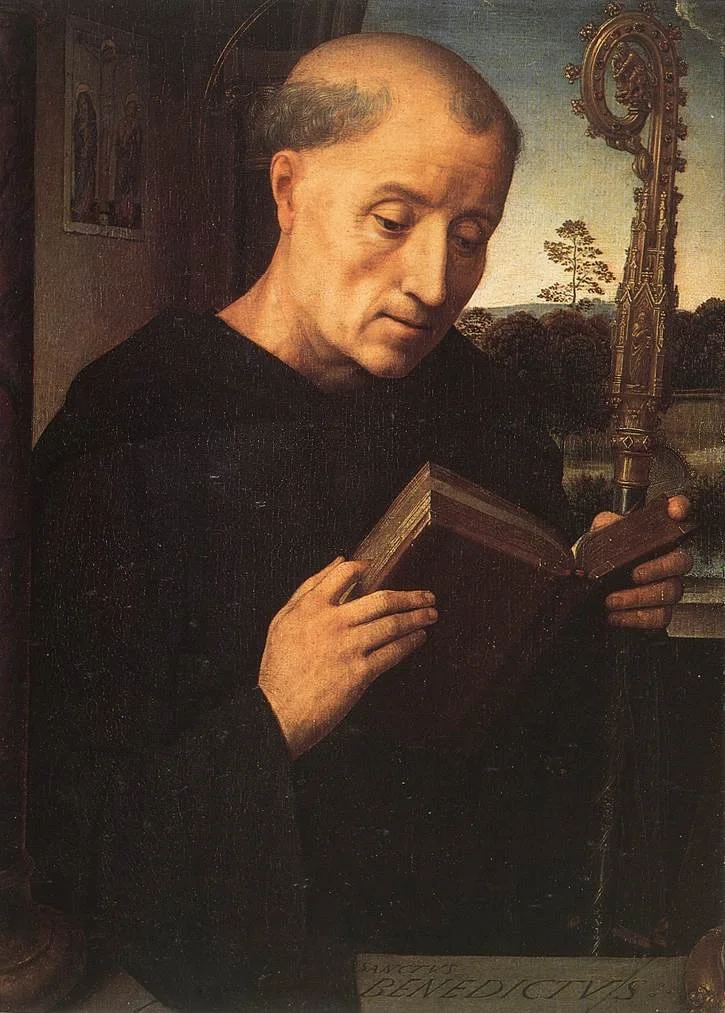
Benedict of Nursia
Benedict of Nursia understood this. When he wrote his Rule in the sixth century (the document that shaped Western monasticism) he did not give monks a choice between prayer and community. He structured life so that one continuously fed the other:
Solitary prayer
Communal gathering
Work alone
Eat together
The rhythm repeated, day after day, because Benedict knew something that busy leaders tend to forget: you cannot give what you have not received, and you cannot receive in noise what only comes in silence.
The monk who skips the cell to spend more time in the refectory is not being more communal. He is slowly emptying out.
The runner who fills every mile with a podcast, a playlist, or a phone call is not training harder. He is avoiding something.
Pulling the headphones out is a spiritual decision. It is choosing the solitude over the noise. It is saying, “I have people to come back to, and I want to come back with something worth giving.”
That long run before the hard meeting was not me neglecting my community. It was me preparing to serve it. The miles processed what the desk could not. The rhythm of effort and breath and pavement created conditions for something I could not manufacture: a settledness. A readiness. A capacity to be present for people who needed me present.
The question is not whether you should train alone or train with others. Some seasons call for a pacing partner. Some call for the solitary miles. The question underneath the question is this: what are you bringing back?
Solitary training is not spiritually neutral time. It is formation time. The long run shapes the person who shows up to the meeting, the marriage, the small group, the hard conversation. The question is whether you are entering that solitude with intention, or just filling it with noise so you do not have to sit with what is actually there.
Benedict built a whole civilization of community on the rhythm of retreat and return. Jesus modeled it in a single verse in Mark chapter one. The pattern is older than either of them.
Go alone. Come back ready.
Your people need you present. FULLY present. Not depleted, not distracted, not arriving with nothing left. The solitude is not where you disappear from community. It is where you become capable of it.
So take the run. Pull the headphones out. Let the pavement do what the desk cannot.
Come back ready to lead.